
NEW STATE BUILDING STANDARDS FOR HEALTHCARE FACILITIES HAVE ENTERED INTO EFFECT
From March 1, 2023, the new DBN V.2.2-10:2022 “Health care institutions. Basic Provisions” entered into force. A team of experts from the public organization “Medical Constructor Expert Analytical Center” was involved in the development of these norms: Vladyslav Smirnov, Viktor Mazur, Viktoria Ulytska, Maria Zasulska, Anastasia Sharlei, Fedor Miroshnikova.
The team of the Center for Public Health expressed gratitude to the working group on the development of new state building regulations. First of all, to the Ministry of Development of Communities, Territories and Infrastructure of Ukraine and the non-governmental organization “Expert Analytical Center “Medical Constructor” for supporting much-needed and important changes in the industry.
The new norms are based on global practices that provide for inclusion and comfort for patients, as well as improved infection control and modern global approaches to the design of medical facilities.
“The norms will currently apply only to new construction, reconstruction and major repairs. That is, there is no need to rework institutions to meet the requirements of the new state construction regulations,” says Roman Kolesnyk, one of the developers of the new construction regulations and head of the Department of Antimicrobial Resistance and Infection Control of the Center for Public Health.
12 main changes that institutions must follow when designing and rebuilding due to combat damage:
- Premises for medical purposes in civil defense facilities at the buildings of health care institutions and/or in dual purpose facilities/premises
In each institution, during new construction and reconstruction, there should be premises for providing medical assistance to the population in emergency situations. For example, combat operations, technological and natural disasters. Medical care in the areas of intensive care, midwifery and surgery will be provided in the specified premises, including a minimum list of laboratory and instrumental studies. - Sanitary and hygienic premises in health care facilities will become available for patients, employees and visitors
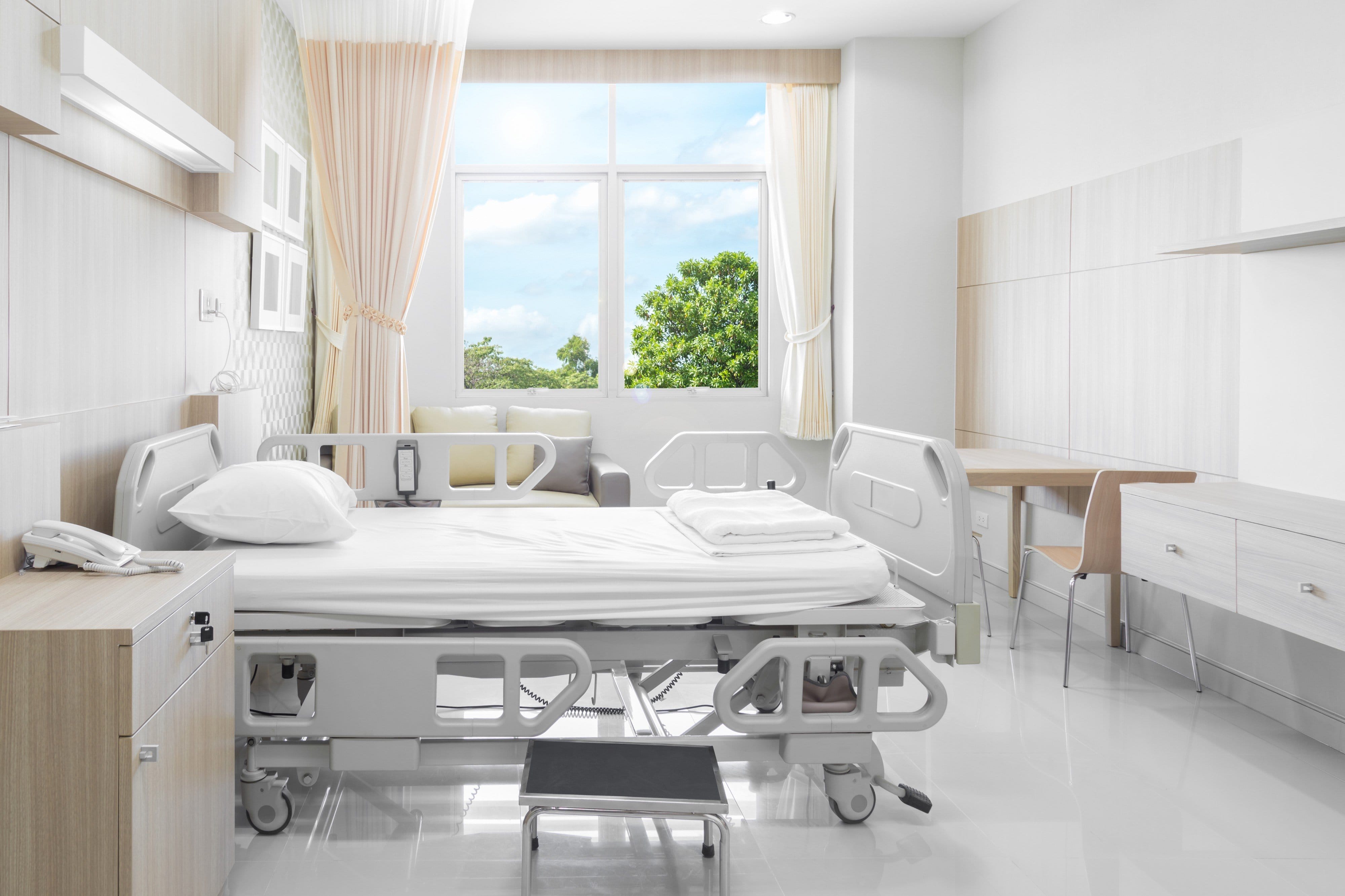
Availability of four types of sanitary and hygienic facilities in health care facilities: public toilets, universal sanitary and hygienic facilities, sanitary and hygienic facilities and sanitary and hygienic facilities with extended functions. Sanitary and hygienic facilities, such as a toilet and a shower area, will be installed in patient wards. In each department of the inpatient institution, a sanitary and hygienic room with extended functions is provided – a room for providing hygienic services to immobile patients. - Patient wards are exclusively single- and double-bed
Patients will be accommodated in single or double wards, which will take into account the requirements for the provision of medical services. First of all, the placement of the bed is not close to the wall, the head end of the bed is free for the access of medical personnel, the distance between the beds in a double room. - Dilution of medical gases, sockets and button for calling a medical worker/help
Requirements for medical gases are determined for various premises of health care institutions, for example, in each ward there must be access to oxygen and sockets, namely, there must be at least three of them near the patient’s bed. Buttons for calling a medical worker are provided not only near the patient’s bed, but also in sanitary and hygienic premises. In addition, it is planned to place help call buttons for medical workers: in case resuscitation measures are necessary. - Updated requirements for lighting, ventilation and fire safety
It is planned to update the requirements for the lighting of the premises of health care institutions, primarily with the aim of improving the orientation of patients. For example, regular lighting in wards and corridors. Requirements for fire alarm systems have been strengthened. - Defined requirements for clean premises of healthcare institutions
The list and minimum requirements for clean rooms are defined. For example, operating rooms, wards of protective isolation of patients, the main of which is the presence of appropriate ventilation and equipment of surfaces. - New approaches to the provision of surgical medical care
The requirements for operating rooms are defined separately for “same-day surgery” and “inpatient surgery”. - New patient isolation wards
Defined requirements for patient isolation wards in the field of combating the spread of infectious diseases (isolation wards for patients with infectious diseases), protective isolation of patients (isolation wards for patients with immunosuppression) and psychiatric care (isolation wards for patients with aggressive behavior). - Premises and areas for relatives/visitors
Improved requirements for waiting rooms in outpatient polyclinic institutions and reception departments of hospitals. Areas are determined according to the number of offices/beds, not according to expected income. Defined requirements for wards of shared stay, including in psychiatric hospitals. In addition, facilities are provided for relatives/visitors who are waiting for the end of medical manipulations, for example, surgical intervention, instrumental examination. - Premises for rest and psychological relaxation of employees of health care institutions
Improved requirements for availability, which will be mandatory in inpatient departments, and the arrangement of employees’ rest rooms. Provision is made for the provision of psychological relief rooms for medical workers for inpatients (at least one room for every 75 workers, for psychiatric workers – for every 50 workers. - The requirements for electricity supply have been changed
The list of premises of health care facilities, in which uninterrupted supply of electricity should be ensured – the absence of no longer than 0.5 and 15 seconds, has been determined. In addition, the requirements for the placement of electricity generators are defined. - Inclusiveness requirements are taken into account as much as possible: sanitary and hygienic premises, wards, corridors, stairs, elevators, entrances, etc.


